What Are Trekking Poles Good For? Types, Proper Use and When to Use Them
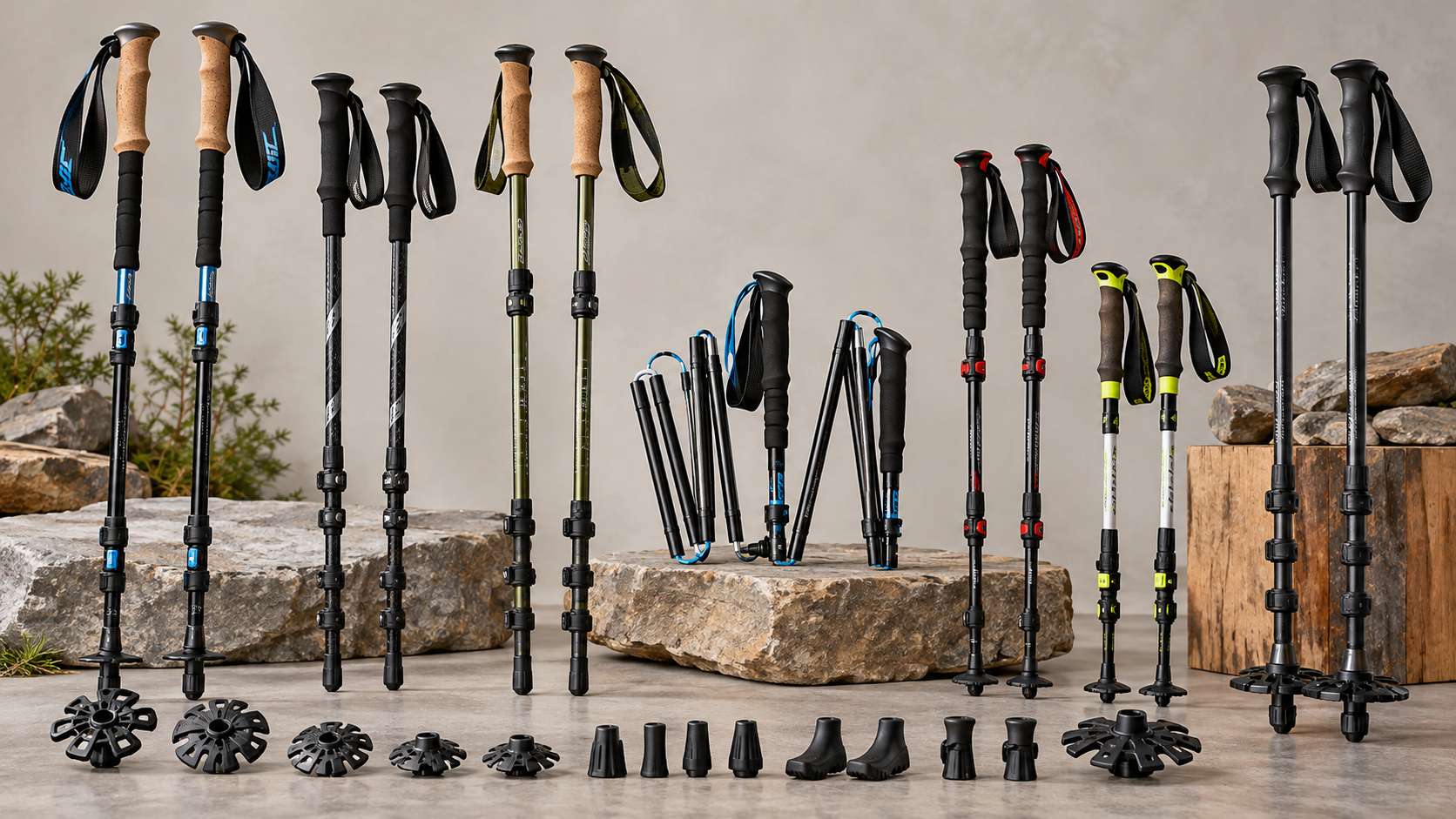
A trekking pole, hiking pole or walking pole is not a piece of equipment only for older hikers, nor is it something that must be used on every trail. A well-chosen and correctly used pole can improve balance, help on steep climbs, reduce some of the load on the lower limbs during descents, and make walking more stable on mud, snow, loose rocks and with a heavy backpack. At the same time, it is not a magic tool: on flat, easy terrain you may not need it at all, while on large boulders or technical sections where your hands are needed, it may actually get in the way. It also matters whether you choose telescopic, folding or fixed-length poles, whether the shafts are made from aluminium or carbon, and what kind of grips, baskets and tips they use. In this guide we look at what trekking poles are really good for, which types exist, how to adjust them, when they are worth using and when it is better to attach them to your backpack.
Two additional points of contact can be especially useful on uneven, slippery or loose terrain.
With proper technique, the upper body can take part of the load generated during each step, potentially reducing stress on the lower limbs.
On level ground, when holding the pole, your forearm and upper arm should form roughly a right angle.
On technical rocky terrain, scrambling sections or easy flat paths, it can often be better to put the poles away.
- Especially useful downhill They help stabilise the body, and some of the load can be transferred through the arms instead of being carried only by the legs.
- They can also help uphill The upper body can contribute to forward movement, especially on long, steady climbs.
- More valuable with a heavy backpack Extra weight affects balance; two poles provide additional support points.
- Telescopic poles are the most versatile They can be shortened uphill, lengthened downhill and adjusted to different users.
- Not always ideal among large rocks If the pole tip cannot be placed securely, or you need your hands for scrambling, put the poles away.
They do not replace walking: they add support, improve balance and redistribute load
The main advantage of trekking poles: you are no longer controlling movement with only two points of support
The difference becomes most noticeable when the trail is steep, slippery, uneven or you are carrying a heavy backpack.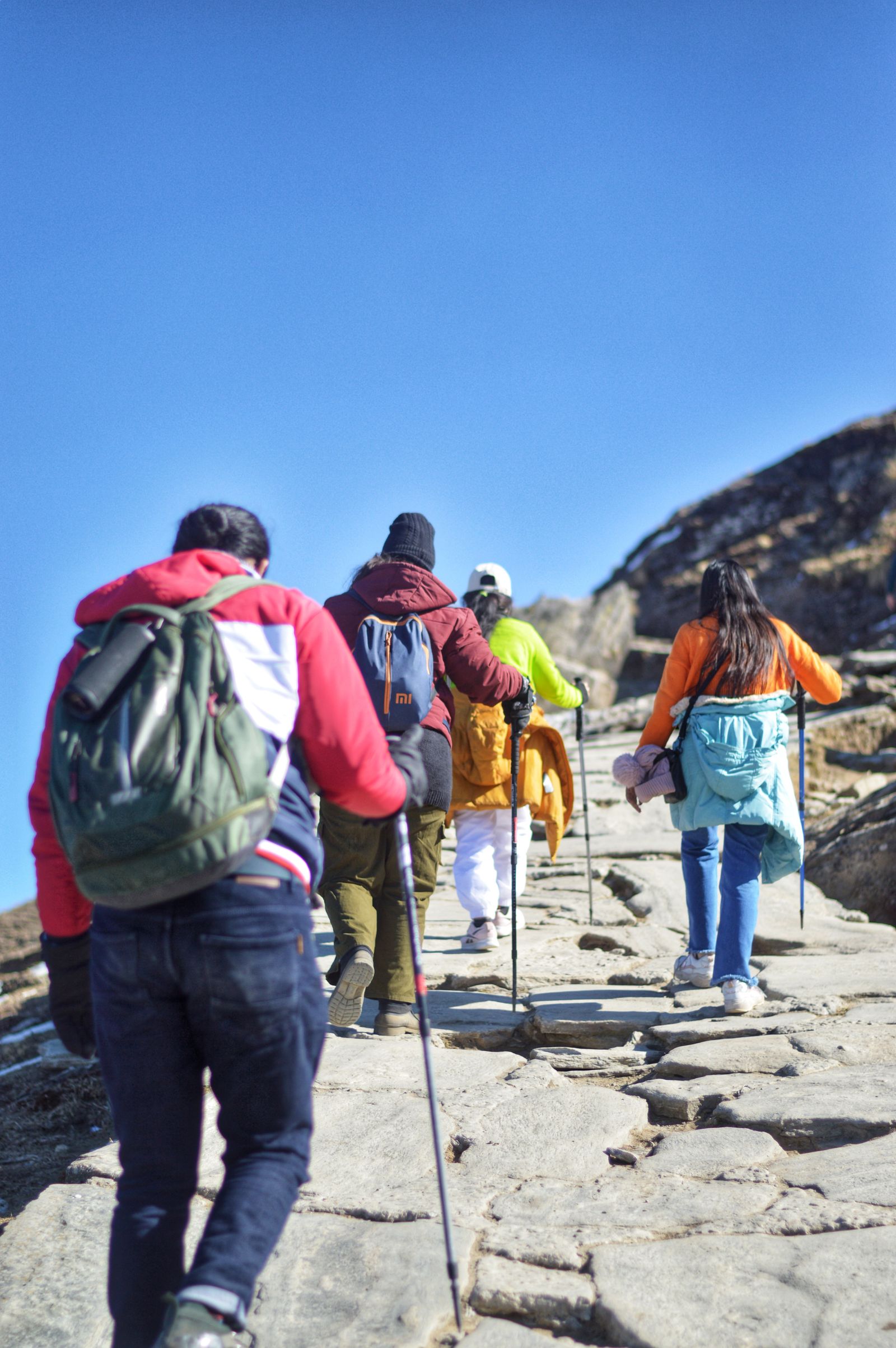
Without poles, your body is moved and stabilised through two main points of contact: your feet. When using two trekking poles, two additional, constantly changing support points are added. This becomes particularly useful when the next step is not entirely predictable, for example on wet roots, loose stones, mud, snow or steep trails.
Trekking poles are not simply a “third and fourth leg”. The muscles of the upper body can also contribute to movement, allowing part of the load to be transferred to the arms and shoulder girdle in certain situations. This is why poles can become particularly valuable on long descents, with a heavy backpack and later in the day when fatigue increases.
Do trekking poles really protect your knees?
In some situations, yes, but not on every type of terrain and not to the same extent for every hiker.One of the most common claims about trekking poles is that they “save your knees”. There is some truth to this, but the statement needs to be more precise. In one biomechanical study of downhill walking, the use of poles produced differences of around 12–25 percent in several measurements including ground reaction forces, knee joint moments, compression and shear forces. Other studies involving heavy backpack loads have also found lower lower-limb joint loading during descents.
This does not mean, however, that trekking poles automatically reduce knee loading by 20 percent with every step. In research on level walking, for example, greater loading through the poles did not produce a measurable reduction in knee compression. Reviews of the available evidence therefore tend to conclude that the benefit of trekking poles depends on the terrain, the load being carried and the technique used.
If there is one situation in which trekking poles are especially useful for many hikers, it is a long, steep descent. Here they can simultaneously improve balance and help redistribute load.
They provide the greatest benefit on descents, steep climbs, with heavy packs and on unstable ground
Eight situations when trekking poles are worth taking out
The decision should not be based on distance alone, but on terrain, load and your own physical condition.Trekking poles can help many people, but they do not replace medical, physiotherapy or rehabilitation advice. If you are considering poles because of pain, a recent injury, surgery or a significant musculoskeletal condition, discuss appropriate loading and technique with a qualified professional.
There are situations where trekking poles can become more of an obstacle than an advantage
The rockier and more technical the terrain, the more important it becomes to decide whether poles still make sense
A pole only provides support when its tip can be placed securely.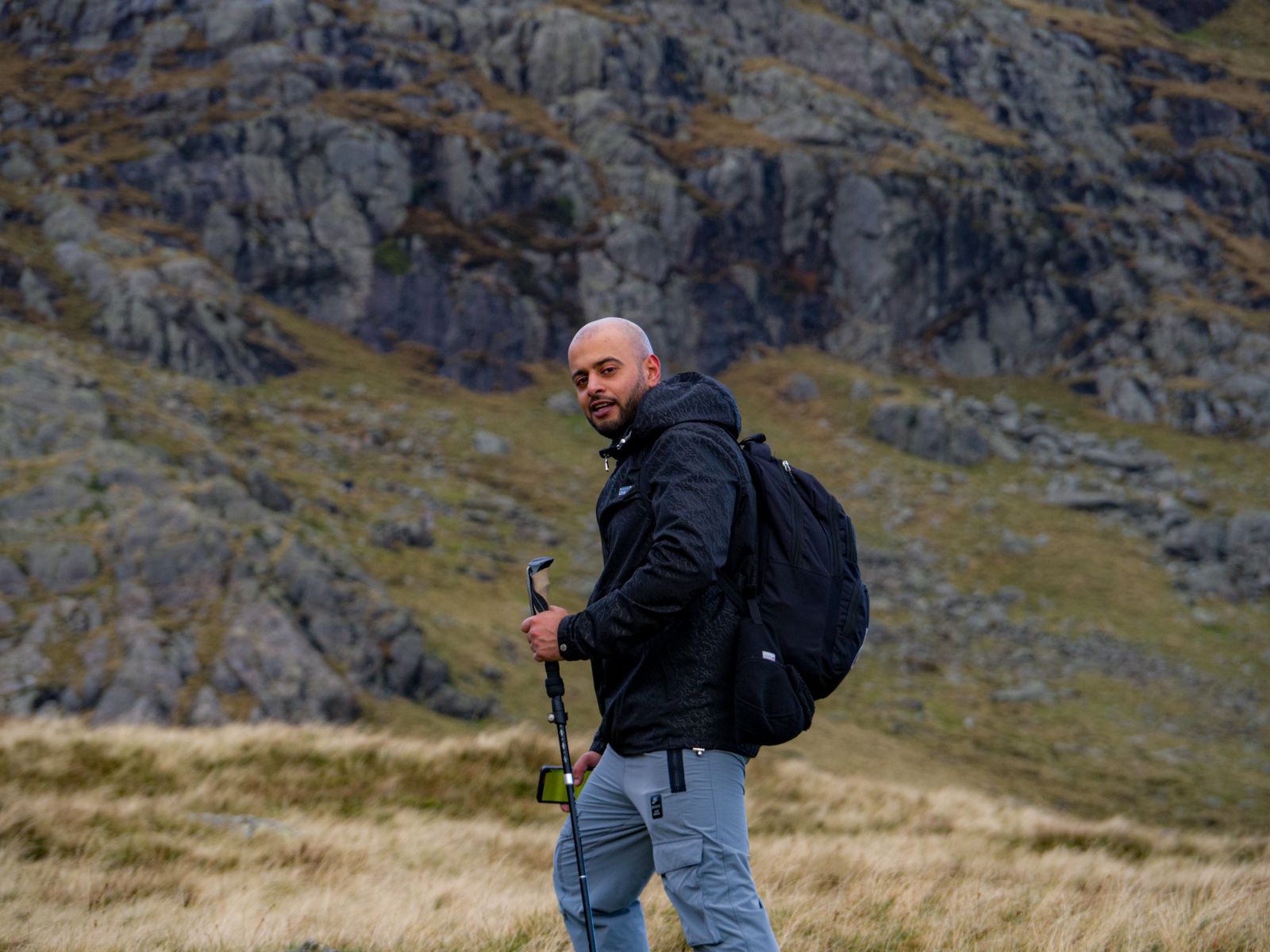
The German Alpine Club specifically notes that on grass, forest ground and muddy paths it is usually easy to find a secure position for the pole tip. On fine scree and increasingly rocky terrain, however, precise pole placement becomes more difficult, while among large boulders poles can sometimes create more problems than benefits.
If the tip slips from the edge of a rock, the pole can suddenly lose its support. On more technical terrain, you are also no longer coordinating only two feet, but four separate points of contact.
Both the UIAA and the German Alpine Club point out that, for healthy hikers, it is not necessarily beneficial to rely on poles on every type of terrain and with every single step. Walking without poles also trains footwork, coordination and balance. Use poles when they genuinely add safety or comfort.
Telescopic, folding and fixed-length poles are designed for different purposes
The construction determines how much the pole can be adjusted, how compactly it packs and how stable it feels
For general hiking, adjustable telescopic poles are usually the most versatile option.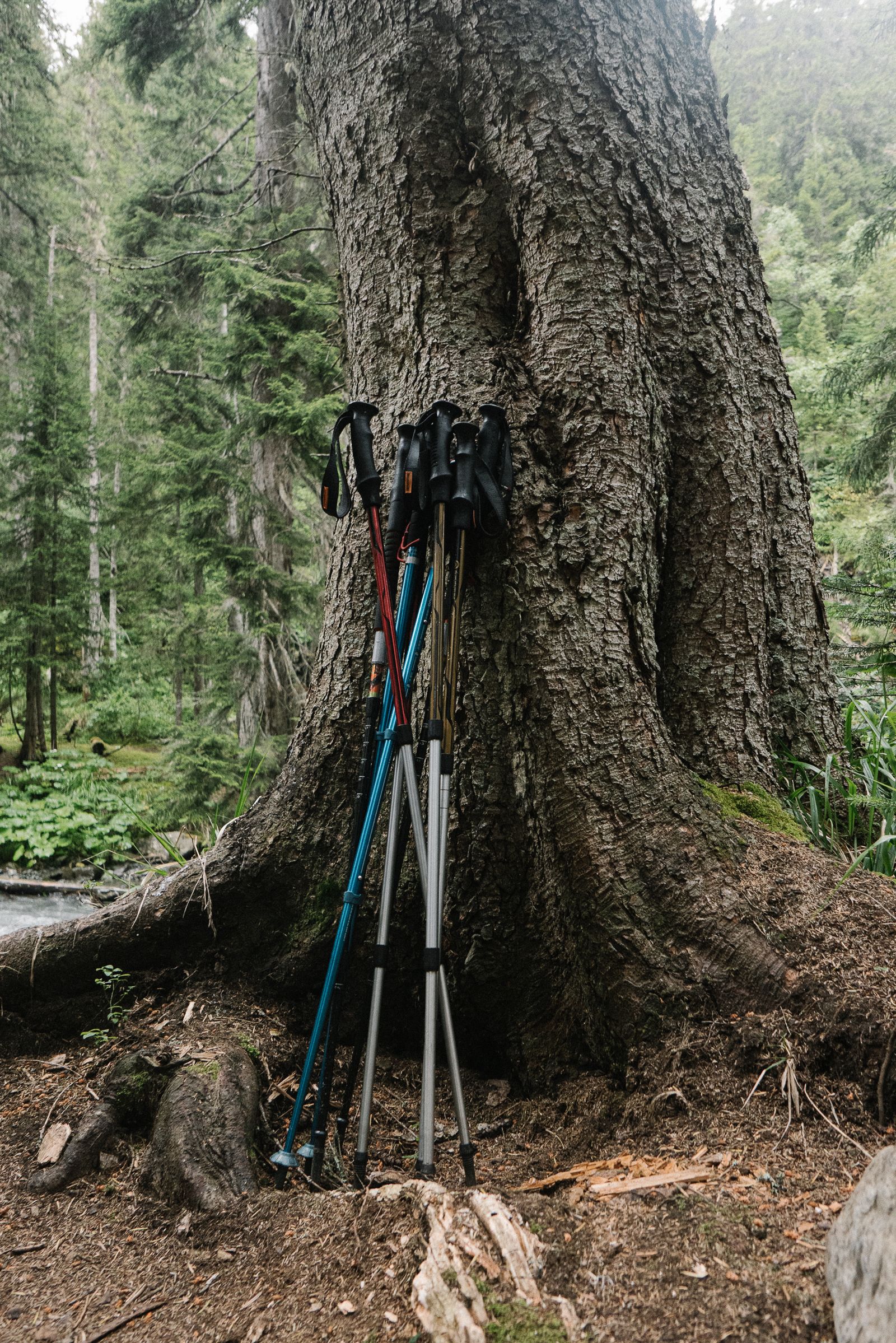
| Type | Advantages | Disadvantages | Best use |
|---|---|---|---|
| Telescopic | Wide adjustment range, robust and versatile. | Usually longer when collapsed than Z-fold poles, with more mechanical parts. | General hiking, mountain routes, heavy backpacks and mixed terrain. |
| Folding / Z-fold | Packs down very small, quick to deploy and generally lightweight. | Some models offer little or no length adjustment. | Trail running, fast hiking, travel and small backpacks. |
| Adjustable folding | Combines the compact packed size of Z-fold poles with some length adjustment. | More complex construction and usually more expensive. | Mountain hiking where both compact storage and adjustability matter. |
| Fixed length | Simple, stiff, lightweight and with fewer potential failure points. | Cannot be shortened uphill or lengthened downhill. | Trail running, racing, fast movement and users who already know their preferred length. |
| Single hiking staff | Simple, with one hand remaining free. | Does not provide symmetrical support on both sides. | Easier terrain and occasional support. |
If you do not yet know exactly what kind of hiking you will use the poles for, a two- or three-section telescopic pole pair with external lever locks is generally the most versatile choice. Later, if low weight or very compact packed size becomes more important, you can move towards Z-fold or carbon models.
Shock-absorbing or rigid poles?
Suspension is optional, and not everyone prefers it.Some trekking poles use an internal shock-absorbing or anti-shock system. The mechanism allows a small amount of axial movement to absorb part of the load applied through the shaft. This can make long descents more comfortable for some hikers.
A rigid pole provides more direct feedback, is usually simpler, lighter and less expensive. Many hikers prefer this because they can feel more precisely how the pole tip is contacting the ground.
Lighter does not automatically mean better: the two materials behave differently under load
Aluminium: durable and usually less expensive. Carbon: lighter and stiffer.
How you intend to use the poles matters more than which material sounds more premium.| Aluminium | Carbon | |
|---|---|---|
| Weight | Usually heavier | Usually lighter |
| Stiffness | Good | Very good |
| Vibration | May transmit more | Often dampens vibration better |
| Overloading | Often bends before breaking. | Can fail suddenly under severe side loading. |
| Price | Usually lower | Usually higher |
| Best suited to | General hiking, heavy packs and durability-focused use. | Ultralight hiking, fast movement and trail running. |
A thicker, high-quality aluminium trekking pole and an ultralight carbon racing pole are designed for very different jobs. Tube diameter, wall thickness, joint construction and locking mechanisms can be just as important as the material itself.
The shaft is only one part of what makes a trekking pole practical
From the grip to the pole tip, every component has a specific job
On a long hike, an uncomfortable grip can be just as annoying as an unreliable locking mechanism.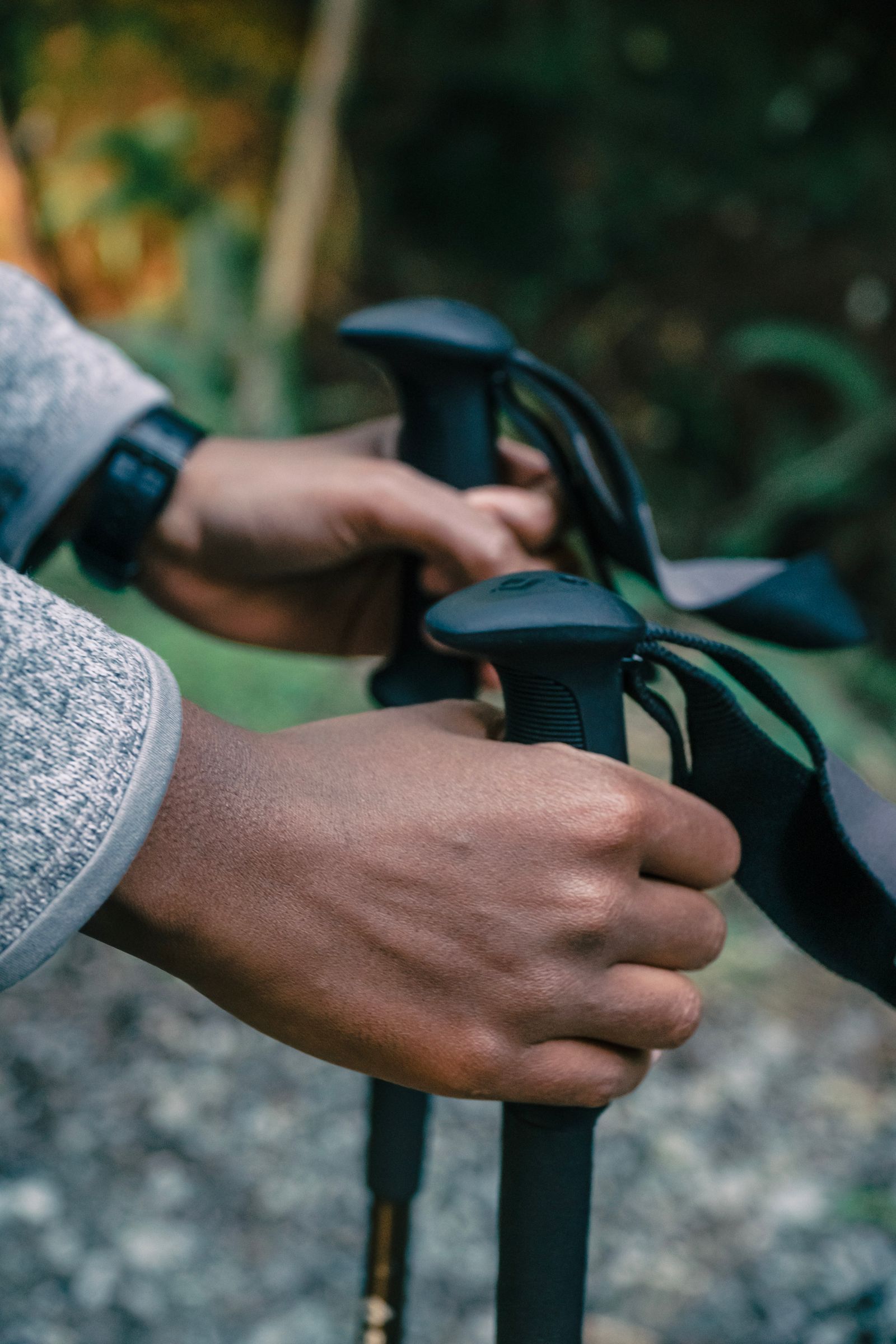
On normal hiking trails, a correctly adjusted strap can help transfer load without requiring you to squeeze the grip continuously. On terrain where the pole could become trapped, where you may need to release it immediately, or where your hands are needed for scrambling, it can be sensible to remove your hand from the strap. Always adapt to the terrain, the pole design and the manufacturer’s instructions.
On level ground, start with roughly a 90-degree elbow angle
The goal is not one exact centimetre value, but a natural, ergonomic body position
Body proportions, terrain and personal technique all influence the ideal setting.Stand upright in the hiking shoes you will actually wear with the poles. Place the pole tip on the ground roughly next to your foot, then hold the grip naturally. As a starting point, your elbow should be bent to around 90 degrees.
This is not a mandatory centimetre-perfect rule, but a practical baseline. If your shoulders are constantly raised, the poles are probably too long. If you have to reach too far down with every step, they are probably too short.
On short, constantly changing terrain, there is little reason to keep opening and closing the locks. With extended grips, you can simply hold the pole lower during a short climb. Actual length adjustment is most useful on long, sustained ascents or descents.
The poles should follow your natural walking rhythm, not wander around far in front of you
In the basic technique, the opposite hand and foot move together
Right foot – left pole, left foot – right pole.During normal walking, the most natural technique is the diagonal pattern. When your right foot moves forward, the left pole moves forward, and on the next step the pattern reverses. This matches the body’s natural opposite arm-and-leg movement.
You do not need to throw the pole far ahead, and you do not need to stab it hard into the ground with every step. The tip should generally contact the ground around the area of the opposite foot, with the pole slightly angled backwards as you continue forward.
At a stream crossing: pole first, foot second
Underwater, you cannot always see whether the next foothold is stable.In a shallow stream or rocky river bed, trekking poles can provide particularly useful stability. Before transferring your body weight, place the pole tip and check that it does not slip, does not move and actually reaches stable ground.
In deeper water, the poles can be lengthened. However, in deep, fast-flowing or flooded water, trekking poles do not automatically make a crossing safe. If the crossing itself is dangerous, choose another crossing point or turn back.
For more demanding hiking, a pair of poles provides the full benefit
One pole can still help, but two poles provide more symmetrical support
The difference is especially noticeable with a heavy backpack and on long descents.| One pole | Two poles | |
|---|---|---|
| Balance | One additional support point | Two-sided stability |
| Descending | Partial assistance | More effective two-sided support |
| Climbing | One arm contributes | Both arms can contribute |
| Heavy backpack | More limited stabilisation | Generally more effective |
| Stream crossing | Useful | Can provide more control |
| Free hand | One hand remains free | Both hands are occupied |
On easy, relatively flat terrain, a single hiking pole or staff may be enough for occasional support. If the goal, however, is to redistribute load during descents, improve stability with a heavy backpack or use poles continuously in mountain terrain, two poles are generally the better option.
They look similar, but they are designed for different types of movement
The main job of a trekking pole is support. The main job of a Nordic Walking pole is rhythmic propulsion.
The grips, straps, tips and techniques are also different.A trekking pole is designed for mountain and uneven terrain. It needs to provide strong support, balance and versatile length adjustment. The user may place a meaningful amount of body weight through the grip.
A Nordic Walking pole, by contrast, is primarily designed for rhythmic movement on more even terrain. The pole is pushed backwards to contribute to forward propulsion, and its specialised glove-like strap system is an important part of the technique.
| Trekking pole | Nordic Walking pole | |
|---|---|---|
| Main purpose | Support and stability | Rhythmic propulsion and exercise |
| Terrain | Mountains, forests, varied trails | Flatter paths, parks, easier terrain |
| Grip | Ergonomic and load-bearing | Slimmer, designed for dynamic movement |
| Strap | Wrist strap assisting support | Special hand-connected strap system |
| Length | Often widely adjustable | Often fixed or adjustable over a smaller range |
For mountain hiking, multi-day routes or carrying a heavy backpack, choose trekking poles. If your goal is to learn proper Nordic Walking technique, use poles specifically designed for Nordic Walking.
The best pole is not necessarily the most expensive or the lightest, but the one that fits your hiking
Quick selector by intended use
First decide where you will use the poles, then compare weight and materials.| Use | Recommended type | Why? |
|---|---|---|
| General weekend hiking | Adjustable aluminium telescopic poles | Versatile, durable, easy to adjust and usually good value. |
| Mountain hiking | Strong, adjustable telescopic or adjustable Z-fold poles | Can be adjusted for climbing and descending, while still being packable for technical sections. |
| Heavy backpack | Robust two-pole system | Here, stability reserve matters more than saving a few grams. |
| Trail running | Lightweight, fixed or minimally adjustable Z-fold poles | Fast to deploy, very compact and low in swing weight. |
| Ultralight hiking | Carbon Z-fold poles | Minimal weight and compact packed size. |
| Winter hiking | Adjustable poles with large snow baskets | The baskets help stop the poles from sinking deeply into snow. |
| First trekking pole purchase | Adjustable aluminium telescopic poles | They make it easy to learn your preferred pole length and adapt to different terrain. |
1. Does the adjustment range fit your height? 2. Does the locking mechanism remain secure under load? 3. Is the grip comfortable? 4. Are the baskets and tips replaceable? 5. Does the pole pack down small enough for your backpack?
Poor trekking pole technique can make the poles less effective and sometimes less stable
Most problems come not from the pole itself, but from adjustment and technique
A few small changes can make a major difference to comfort and effectiveness.Trekking poles work best when they are used for the terrain, not simply out of habit
Stability, load distribution and better control
Trekking poles provide additional support, can help control body weight and backpack load, and can be particularly useful on long descents, steep climbs, mud, snow and stream crossings.
For general hiking, adjustable telescopic poles are the most versatile
Folding Z-poles are useful when low weight and compact packed size matter most, while fixed-length poles are more specialised for fast movement. Aluminium models are generally more robust, while carbon models can be lighter.
When they genuinely improve safety, stability or load distribution
On descents, with a heavy backpack, on unstable ground and during long mountain hikes, trekking poles can be extremely useful. On simple, flat trails they may not be necessary, while before large boulder fields, chain-assisted passages or scrambling sections, it is often better to attach them to your backpack. Good trekking poles do not walk for you: they help you move more steadily, more controllably and more comfortably when the terrain actually calls for them.


Sources and technical background
The biomechanical effects of trekking poles are not identical on every type of terrain or for every user. For this reason, the article distinguishes between benefits supported by research during descents and load carrying, and broader claims that poles automatically reduce knee loading in every situation.
- Wilderness & Environmental Medicine – Are Trekking Poles Helping or Hindering Your Hiking Experience? A Review
- Journal of Sports Sciences – Knee joint forces during downhill walking with hiking poles
- Medicine & Science in Sports & Exercise – Effects of hiking downhill using trekking poles while carrying external loads
- Scandinavian Journal of Medicine & Science in Sports – Knee compression during level walking with hiking poles
- Medicine & Science in Sports & Exercise – Muscular and metabolic costs of uphill backpacking
- Deutscher Alpenverein – Trekkingstöcke richtig einsetzen
- UIAA – Advantages and Disadvantages of Using Hiking Sticks in the Mountains
- REI Expert Advice – How to Use Trekking Poles and Hiking Staffs
- REI Expert Advice – How to Choose Trekking Poles and Hiking Staffs
- LEKI – Trekking poles, trail running poles and Nordic Walking poles: differences
Photos used in the article:
- Pexels – Ayoub Haloumi II: hiker with trekking poles in rocky mountain terrain – hero image
- Pexels – Ravi Kant: trekking poles in use on a rocky mountain ascent
- Pexels – Vintage Laka: trekking pole use on rough rocky terrain
- Pexels – Darina Belonogova: trekking poles as standalone hiking equipment
- Pexels – PNW Production: close-up of trekking pole grips and wrist straps
- Pexels – Alin Serban: trekking poles on rocky mountain terrain
- Pexels – Yaroslav Shuraev: hikers using trekking poles in snowy mountain terrain
- Pexels – Duran Ekiz: trekking poles on a steep snowy mountain slope