Pocket Knives and Knives for Hiking: What Should You Bring?
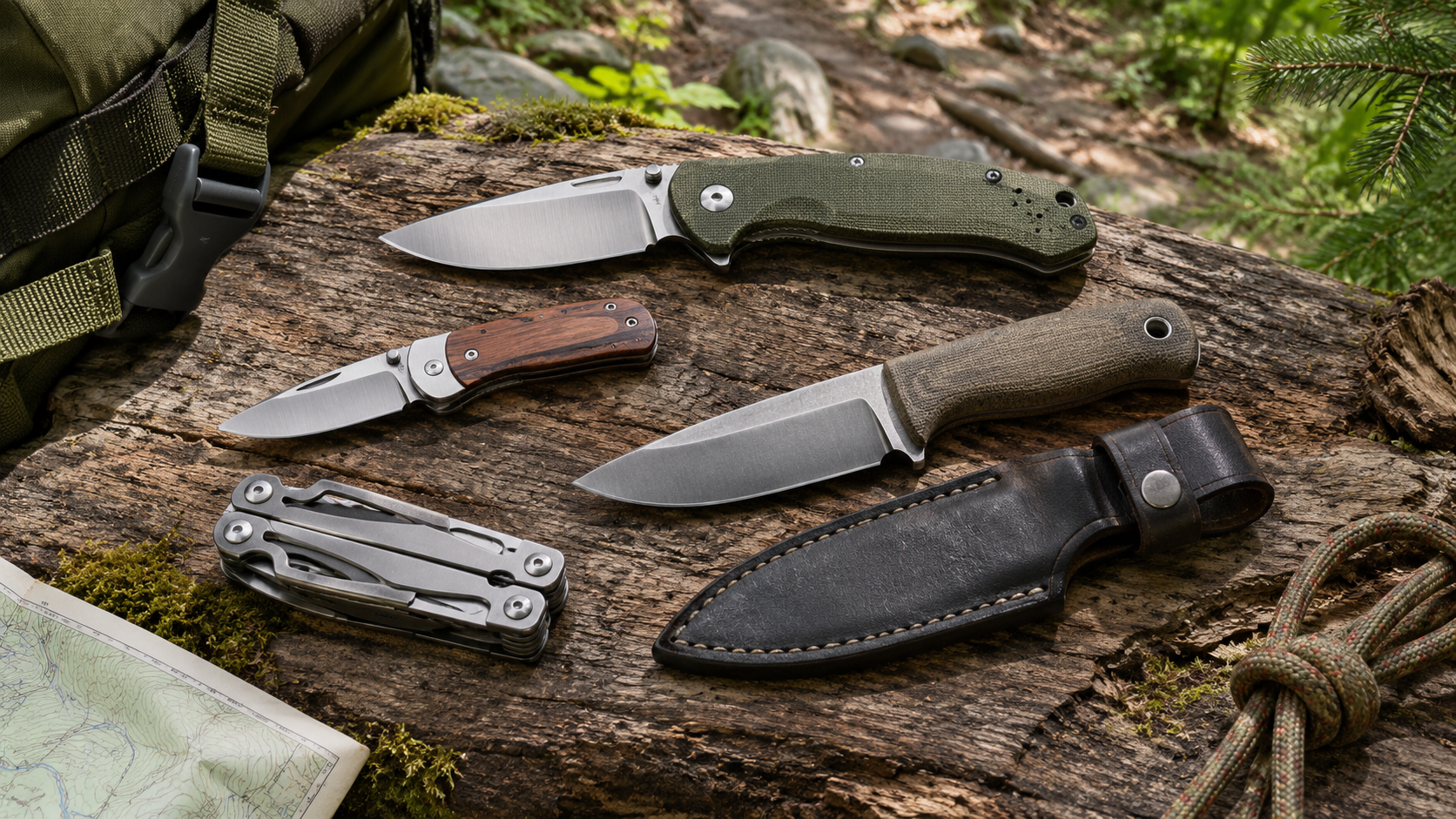
Folding pocket knife, fixed-blade knife or multitool? Opening food packets, preparing meals, cutting cord, making kindling, carving cooking skewers and wooden tent pegs: which tool works best for each job?
For a day hike, a compact pocket knife or small multifunction tool is usually enough.
The cutting task determines the most suitable blade.
A light pocket knife is useful for packaging and food; controlled woodwork generally calls for a sturdy fixed blade.
Hungarian regulations treat cutting edges or stabbing lengths exceeding 8 cm as a separate category.
Do you actually need a knife on a hike?
The question is not whether it is sold as a “survival knife”, but exactly what you intend to do with it.
Opening a food packet or slicing a sandwich is easy with a small pocket knife. Working thicker, dry wood or carving kindling is more comfortable with a sturdier knife and a secure grip. For cutting bandages, adhesive tape, fishing line or thin plastic straps, however, the scissors on a multitool are often better. Let the task guide the choice.
A compact, easy-to-clean folding knife or small multifunction tool. The blade may only be needed occasionally.
A comfortable handle, a lock you can check or a suitable sheath; choose an easy-to-clean blade for food preparation.
Scissors, a screwdriver, pliers or a saw can be useful. A multitool may be more practical than a larger knife.
A fixed blade can help with sustained work, but size, transport and legal requirements need separate consideration.
If you mainly cut food and open packaging, a heavy, thick “survival” blade is unnecessary. You may encounter several cutting tasks on one hike, but not every task requires a knife.
Pocket knife, fixed blade or multitool?
Three different kinds of tool, each with its own limitations.
| Tool type | Main advantage | Limitation | A good choice when… |
|---|---|---|---|
| Folding pocket knife | Compact, light and easy to pack. | The pivot and locking mechanism need cleaning and inspection. | You cut food, cord and packaging, and often pass through towns or other public areas. |
| Fixed-blade knife | No folding pivot; easy to clean and offers direct control. | Requires a sheath; may be longer and take up more space. | You genuinely work with wood or camp materials often, and possession and transport comply with the law. |
| Multifunction pocket knife | Scissors, screwdriver, can opener and sometimes a saw in one compact body. | Extra functions can add weight and make the grip less comfortable. | You also make minor repairs and know which individual tools you actually need. |
| Pliers-based multitool | Sturdy pliers and useful screwdriver components. | Usually heavier; its blade may be shorter and less comfortable to use. | You repair metal parts, buckles, trekking poles or cycling equipment. |

What does a locking blade actually do? A reliable lock can reduce the risk of a blade closing accidentally, but it does not turn a folding knife into a fixed blade. Do not use the lock as an excuse to pry sideways or lever with the tip.
Blade shape, cutting edge and grind: which is useful for what?
Blade shape and thickness can matter more than the brand name.
The spine slopes gently down towards the point. A versatile shape for everyday camp cutting, generally straightforward to control.
A less pointed shape can be useful for cutting packaging and webbing, although the exact tip geometry varies by model.
Well suited to food, packaging, cord and detailed wood carving; easier to guide for precise cuts.
May help with fibrous materials such as rope or webbing; a plain edge is better for fine carving.
Why is a thicker blade not always better? A thick blade may look tougher, but when cutting a tomato, cheese or a thin strap it can push the material apart with more force. A thinner blade often gives more precise results.
“Full tang” describes how the blade material extends into the handle; it is not a universal quality rating. It may be irrelevant on a day hike but more important during sustained woodwork.
Food bags, packaging and cord: which blade works best?
For small tasks, control and accuracy matter more than blade size.
| Task | Most practical tool | Why it works |
|---|---|---|
| Opening a food bag, cereal bar or vacuum-packed meal | Small pocket knife or multitool scissors | A short, controlled cut avoids stabbing too deeply into the contents. |
| Slicing bread, cheese or fruit | Pocket knife with a thinner, plain blade | Less likely to split soft food than a thick survival blade. |
| Cutting a cable tie or adhesive tape | Multitool scissors | Cuts in a small area and is less likely to damage the material underneath. |
| Cutting paracord or thin cord to length | Sharp plain blade or good scissors | A clean cut limits fraying. Do not casually cut rope while it is under tension. |
| Opening a tin, bottle or metal closure | A purpose-made opener | A knife blade is not a can opener or screwdriver: it can slip or become damaged. |
Do not use a food-preparation blade on resinous or dirty wood, or on hardware contaminated with lubricants. Multitool scissors and a clean pocket-knife blade complement each other when you have several jobs to do.
Locks, handles and sheaths: what matters in real use?
Control while cutting matters more than a flashy opening mechanism.
- Slipjoint, a non-locking pocket knife: a spring holds the blade open, but there is no mechanical lock. It can be useful for cutting; pressure in the closing direction may fold the blade.
- Liner lock, frame lock and back lock: different locking designs. With any of them, check that the lock engages fully and that the mechanism has no excessive play or debris.
- Rotating locking ring: on some classic pocket knives, the ring must be turned manually after opening the blade; moisture or a swollen wooden handle can affect its operation.
- Handle: try it with dry and wet hands and, if possible, with gloves. Sharp edges, a cramped grip or a clip that presses into your palm become uncomfortable during longer jobs.
- Fixed-blade sheath: it must retain the knife securely, stop the point from piercing through, and remain closed inside a backpack.

With the blade open, check for side-to-side play and confirm that the lock engages clearly. When folding it, keep your fingers out of the blade’s path. A mechanical lock does not replace careful handling.
Ten real hiking tasks: which tool should you reach for?
A quick decision table: the job matters more than the price or size of the knife.
| What needs doing? | Recommended tool | Practical reason |
|---|---|---|
| Opening food packaging | Small pocket knife or scissors | A short, precise cut makes it easier to avoid the contents and your fingers. |
| Cutting an apple, cheese or bread | Pocket knife with a thin, plain blade | Slices more easily than the thick, short blade on many multitools. |
| Cutting repair cord or paracord | Sharp pocket knife or multitool scissors | A controlled cut with little force; the rope should not be under load. |
| Cutting tent-repair tape to size | Multitool scissors | Less likely to scratch the tent fabric than a pointed blade. |
| Cutting a bandage or clothing safely | Blunt-tipped first-aid scissors | Near the body, use scissors designed for the job rather than a knife. |
| Making dry kindling or thin wood shavings | Fixed-blade knife with a comfortable grip | There is no folding joint during longer, controlled carving. Kindling is only relevant where making a fire is lawful. |
| Shaping a wooden cooking skewer or tent peg | Fixed-blade knife or securely locking pocket knife | A firm grip makes small carving cuts easier to control. |
| Cutting thicker pieces of wood | Compact saw | Striking or prying with a knife is no substitute for the right tool. |
| Repairing a trekking pole, buckle or screw | Pliers-based multitool and the correct screwdriver | A blade is not meant for turning screws or levering metal parts. |
| Cutting fishing line or thin tape | Small scissors | More precise than a large camp knife. |

What can a knife do when preparing a campfire — and what should it not do?
A knife can help prepare kindling; it does not make the fire for you.
A sturdy fixed blade can carve fine, easily ignited shavings from dry, fallen wood. A securely locking pocket knife may be enough for very small pieces, but do not lever or force it.
Fine curls left attached to a stick offer more surface area to catch a flame, particularly when the inner wood is drier than the outside. A comfortable fixed blade with a plain edge is useful here.
A small saw is the better tool. Do not strike a folding knife into wood, twist its blade sideways or overload its lock.
If the manufacturer supplies a separate striker, use it. The knife’s cutting edge is not designed for that job; not every fire-starting task belongs to the blade.
Preparing kindling and lighting a fire are different activities. Before lighting a fire, check whether it is permitted at that location and whether a fire ban is in force. Avoid damaging living trees or protected natural features.
Cooking skewers, tent pegs and pointed sticks: which knife works?
For carving, a secure grip matters more than a long or impressive-looking blade.
| Task | Tool | Why choose it? |
|---|---|---|
| Carving a cooking skewer | Small fixed blade or securely locking pocket knife | Suitable for shaping thin wood; remove splinters and use a skewer only where a campfire is permitted. |
| Making a wooden tent peg | Fixed blade; saw for cutting the wood to length | Shaping one end is a carving job, but splitting a thick branch with a pocket knife is not worthwhile. |
| Carving a point on a wooden stick | Fixed blade with a secure grip | More stable for a longer piece of wood than a non-locking pocket knife. A sharply pointed, spear-like stick poses a significant injury risk and is generally unnecessary for hiking. |
| Shaping a small wooden wedge or camp support | Fixed blade and a separate saw | Use the knife for fine shaping and the saw for cutting to length; do not pry or lever with the side of the blade. |
| Cutting torn fabric, packing cord or tape | Multitool scissors | A knife suited to woodwork is unnecessarily large and less accurate for these jobs. |
Why not use a non-locking knife for this? During woodwork, force sometimes acts against the opening direction of the blade. Without a lock, the blade can unexpectedly fold. For extended carving, a sturdy fixed blade carried in a suitable sheath is the more sensible choice.
Splitting thick logs, prying out nails or screws, and working stone or metal are not ordinary knife tasks. They require other tools; a larger blade is not the answer.
Carrying a knife on a hike: what does the 8 cm rule mean?
Hungary does not have a simple rule that “everything under 8 cm is allowed everywhere and everything over it is banned everywhere”.
Under Hungarian Government Decree 175/2003 (28 October), tools with a cutting edge or piercing length exceeding 8 cm are classified as items particularly dangerous to public safety. The decree also specifically covers switchblades, regardless of size. “Exceeding” matters: the threshold is not the length of the sheath or the fully opened knife.
| Location or situation | What to consider |
|---|---|
| Public spaces, publicly accessible places and public transport | As a general rule, the decree prohibits possession of the listed dangerous items in these places. Any exceptions must be assessed narrowly and against the actual reason for carrying the tool. |
| Work, sport and ordinary daily activities | Exceptions related to the tool’s intended use may apply. When transporting it outside that activity, concealed, packaged or closed storage can matter. |
| Events, stadiums, institutions and border crossings | Entry requirements and the destination country’s laws may impose further restrictions. Permission under Hungarian rules does not automatically mean the same item is lawful abroad. |
| Air travel | Do not plan to carry knives or other sharp tools in cabin baggage. Check the airport, airline and destination-country rules in advance. |
Whether a larger knife packed for a multi-day hike is lawful may depend on the actual activity and how it is transported. Saying “I am hiking” is not an automatic exemption. A blade shorter than 8 cm does not exempt you from other rules governing a location or your conduct.
Which one should you bring? Four practical setups
The goal is not to carry the most equipment, but to bring tools that can do the work you plan.
Small pocket knife or a pocket tool with scissors. For opening packaging, cutting fruit or thin cord, a heavy fixed blade makes little sense.
A multitool with scissors and a screwdriver, plus a lightweight pocket knife if needed. Useful for tape, webbing ends, buckles and equipment repairs.
A small-to-medium fixed-blade knife with a suitable sheath, and perhaps a separate saw. For preparing kindling, skewers, wooden tent pegs and small wooden parts.
Pliers-based multitool with bit heads suited to the equipment. A pocket knife cannot replace a screwdriver, hex key or pliers.
If the task is cutting, a light, comfortable blade is enough. If it involves repairs, bring a multitool. For extended wood carving, a sturdy fixed blade is better. For cutting thicker wood, a saw is the appropriate tool.
What should you take for the job at hand?
You do not need a large knife for cutting
A compact pocket knife works for packaging, food and cord; scissors are often more precise for bandages and adhesive tape.
Carving calls for a stable tool
Use a fixed blade for shaping kindling, skewers and tent pegs, and a saw for cutting thicker wood.
Transport is a legal consideration too
Check the 8 cm legal threshold, any legitimate-use exceptions and the rules in your destination country.

Sources, legislation and photo credits
Legislation and background sources: Checked in November 2026. This legal information is for general guidance; current legislation and the specific circumstances take precedence.
- Hungarian Government Decree 175/2003 (28 October) – items particularly dangerous to public safety
- Current Hungarian legislation – Jogtár
Photographs and credits: The photographs come from identified Wikimedia Commons file pages. Images are scaled without cropping in the article.
- Open Opinel No. 08 pocket knife with wooden handle and locking ring — Kuroczynski — CC BY-SA 4.0 (scaled)
- Mora Kansbol fixed-blade outdoor knife alongside hiking equipment — Olgierd — CC BY 2.0 (scaled)
- Open multifunction Swiss Army knife with several tools — Simon A. Eugster — CC BY-SA 3.0 (scaled)
The regional photos on the Túraprogramok cards illustrate the surrounding areas; they are not photographs of a product test at the hike location.