

Bees vs. Wasps: Which Sting Is More Dangerous, and What Happens in Your Body?
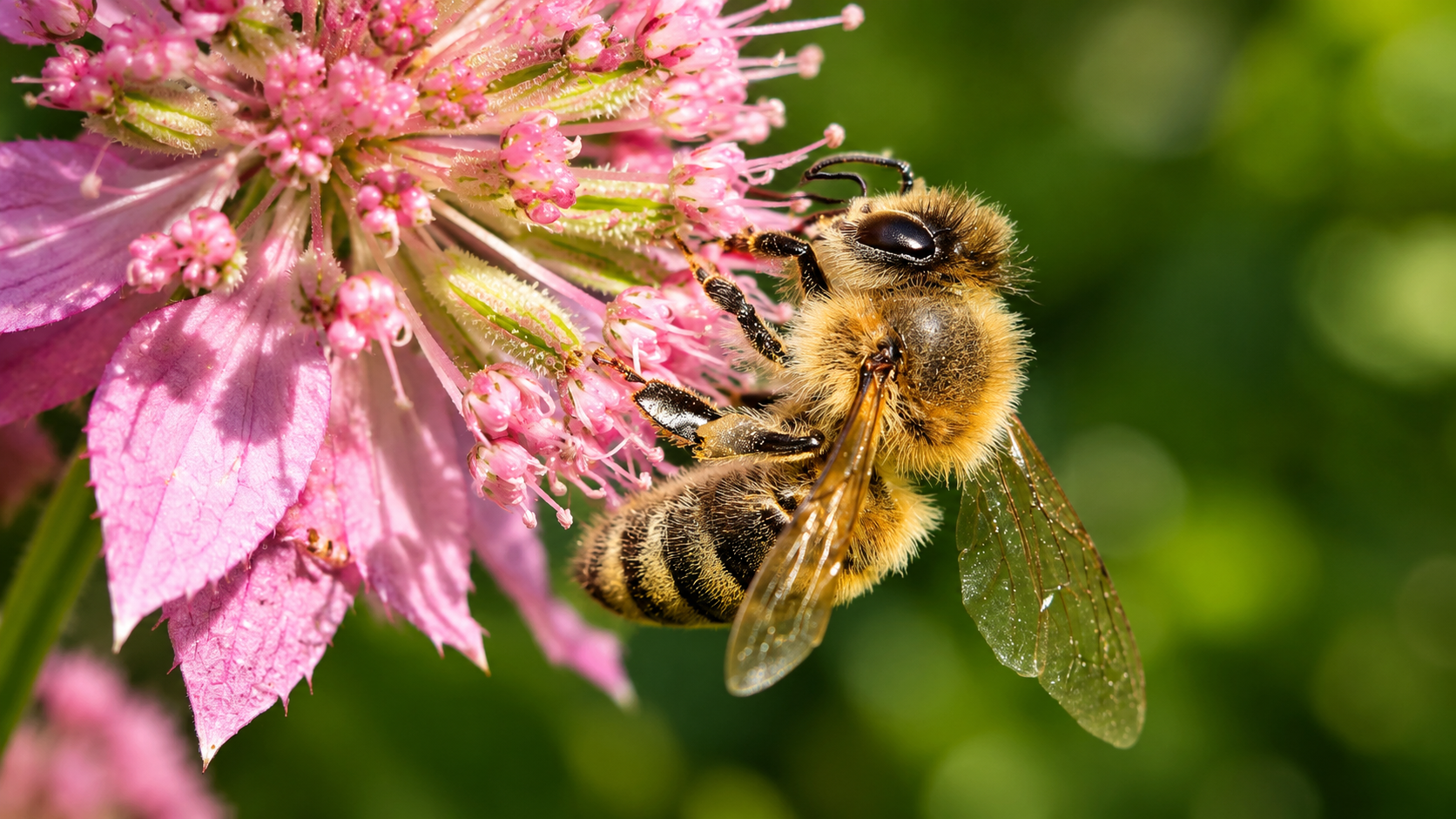
Bees and wasps can look similar, but they feed differently, defend their nests differently, and have different venoms. Identification, sting risk, venom effects and first aid: the differences that really matter.
Hair, body shape, nest structure and feeding behaviour.
A honeybee’s stinger often stays in the skin; a wasp can sting repeatedly.
Individual allergies and the number of stings determine the risk.
Breathing difficulties, throat swelling or faintness: call 112.
Bee or wasp? The differences that really help
Black-and-yellow stripes alone are not enough: body shape, hair and behaviour provide more reliable clues together.
Honeybees are generally browner, hairier and stockier. Common and German wasps are conspicuously yellow and black, with smoother bodies and narrower waists. However, a quick glance is not always enough: some wasps resemble bees, hoverflies mimic wasps, and individuals can vary in colour.
| Feature | Western honeybee (Apis mellifera) | Social wasp (Vespula spp.) |
|---|---|---|
| Body | Denser hair; brownish-gold or greyish bands | Smooth, bright yellow-and-black markings; narrower waist |
| Foraging | Flowers; collecting nectar and pollen | Flowers and protein-rich prey; often human food and sweet drinks |
| Stinger | Often remains embedded in human skin; the worker usually dies | Usually does not remain in the skin; the same wasp can sting repeatedly |
| Nest | A colony living on wax combs in a hive or cavity | A papery nest, sometimes in buildings, underground or in sheltered cavities |
| Risk | A single sting can trigger anaphylaxis in a susceptible person | The same applies; nest defence can also lead to multiple stings |
Allergies to bee and wasp venom can develop independently. If a severe reaction has occurred, an allergist can help identify the stinging insect through appropriate testing; this is not something to spend time on during an emergency.
Six bee and wasp species found in Hungary: which can sting?
The term “wasp” covers many insects. Social species that strongly defend their nests behave differently from more peaceful solitary species or those living in smaller colonies.
Female workers can sting. A honeybee collecting nectar from flowers usually does not attack; the risk of a sting rises near a hive or when the insect is trapped.
Females can sting; males cannot. Usually a peaceful flower visitor, but may defend its nest if disturbed.
Well adapted to human environments and a frequent visitor to terraces and picnic areas. It defends its nest vigorously.
A social species similar to the German wasp. Accidentally disturbing nests underground or inside buildings is particularly risky.
A large wasp whose sting can be painful. Its size does not automatically make every sting more dangerous than one from a smaller wasp.
A slender wasp with long legs, often found on exposed, open-comb nests. Usually less confrontational, but capable of stinging near its nest.


Bumblebees, hornets and paper wasps: size does not equal danger
A larger insect may look more intimidating, but the real risk depends on the number of stings, the body’s response and the situation.
Bumblebee: a robust, very hairy bee. Bumblebees are important pollinators; some can vibrate flower structures to release pollen. Females have stingers and may sting repeatedly because their stingers do not usually detach as honeybee stingers often do.
Hornet: larger than common wasps, with reddish-brown and yellow colouring. Its size does not automatically mean a greater allergy risk. It defends its nest, so particular care is needed around tree hollows or openings in buildings.
Paper wasp: often easier to recognise by its exposed, open-celled nest than by the insect seen at a distance. Low-lying nests, such as those beneath railings or eaves, can be disturbed accidentally.


Why are they attracted to food, and when do they become defensive?
A wasp landing on your table and a wasp defending its nest are two very different situations.
Around food: social wasps look for protein as well as sugar. This is why they may investigate soft drinks, fruit, meat or cakes. Their interest in human food can be more noticeable in late summer and autumn, but that does not mean they are “attacking for no reason”.
On flowers: honeybees and bumblebees are primarily foraging. Wasps also visit flowers and can contribute to pollination. The idea that “bees are useful and wasps are useless” is biologically incorrect.
| Situation | Likely behaviour | What to do |
|---|---|---|
| A wasp on the rim of your glass | Investigating a possible food source | Put the drink down and check it before taking a sip; do not bring the wasp towards your mouth. |
| A bee on a flowering shrub | Collecting nectar or pollen | Let it forage; do not grab it or trap it in your clothing. |
| Insects flying in and out of a hole in the ground | Possible nest entrance | Move away slowly; do not stand in front of the entrance or tread around it. |
| Several wasps follow you and begin stinging | They may be defending a nest | Move decisively away from the nest area; protect your face rather than swatting at the insects nearby. |
An individual insect foraging alone usually behaves differently from one that perceives a threat to its nest. Recognising the situation is often more useful than trying to identify the exact species in seconds.
Bee and wasp venom: how do they differ, and which is stronger?
There is no medically useful universal ranking of “bee versus wasp venom strength”. Effects depend on venom composition, the amount injected and individual sensitivity.
Honeybee venom: one important component is melittin, which affects cell membranes and contributes to local pain and inflammation. phospholipase A2 (Api m 1) is a major allergenic protein, while hyaluronidase is an enzyme involved in the spread of venom through tissues.
Social wasp venom: has a different protein composition. Important allergens include phospholipase A1 (Ves v 1) and antigen 5 (Ves v 5). Wasp stings can also cause intense local pain, inflammation and anaphylaxis.
| Question | Evidence-based answer |
|---|---|
| Is wasp venom always stronger? | No. Neither the pain of a sting nor the insect’s size reliably predicts how severe the reaction will be for a particular person. |
| Are bee and wasp venoms the same? | No. They contain some shared or similar proteins, but there are important differences in their allergen profiles. |
| Is someone allergic to bee venom necessarily allergic to wasp venom too? | No. Positive tests for both venoms can sometimes reflect cross-reactivity; an allergist assesses their clinical significance. |
| Is there an antivenom you can use at home? | No. Adrenaline (epinephrine) is the lifesaving emergency treatment for anaphylaxis; venom immunotherapy is a separate preventive treatment provided later. |
One sting may be life-threatening in someone with a severe allergy, while another person may experience mainly local symptoms after several stings. However, many stings at once can also produce a toxic effect even without an allergy and require urgent medical assessment.
After a sting: local reaction, major swelling or anaphylaxis?
The type of symptoms matters more than a presumed identification of the insect.
Sharp pain, redness, itching and limited swelling around the sting. First aid and symptom relief are usually sufficient.
Swelling may extend across a joint or a substantial part of a limb and last for days. This is not the same as systemic anaphylaxis, but severe symptoms or suspected infection warrant medical assessment.
Hives away from the sting site, faintness, vomiting or breathing problems. Suspected anaphylaxis requires immediate emergency treatment.
A large number of stings can cause direct toxic effects, even in someone without a previous allergy. Urgent medical assessment is required.
Anaphylaxis can cause breathing or circulatory problems without a skin rash. Call 112 for throat tightness, difficulty breathing, dizziness with weakness, fainting or sudden confusion.
Extensive local swelling may be painful and alarming, but it does not, by itself, prove that the venom is “stronger”. Severity and progression should be assessed from the symptoms.
What should you do after a bee or wasp sting?
In the first few minutes, the priorities are removing any embedded stinger, caring for the sting site and recognising signs of an allergic reaction.
- Move away if there is a risk of further stings. This is especially important near a nest, where several stings can occur in quick succession.
- If a stinger remains in the skin, remove it promptly. Scrape it away with a fingernail or the edge of a card if convenient; do not waste time searching for a special tool.
- Wash the area with soap and water. A cool compress or a cold pack wrapped in cloth may reduce pain and swelling. Do not apply ice directly to the skin.
- For local itching, an antihistamine or other appropriate symptom relief may be considered on the advice of a pharmacist or doctor. These treatments do not treat anaphylaxis.
- If breathing or circulatory symptoms, or severe general illness, develop, call 112 and use a prescribed adrenaline (epinephrine) auto-injector immediately. Do not wait for a rash to appear.
A honeybee’s stinger often remains in the skin together with its venom sac. Prompt removal matters more than spending time debating the exact technique. Wasps usually do not leave a stinger behind, but the absence of one does not by itself identify the insect.
When is adrenaline needed, and why are antihistamines not enough?
Anaphylaxis is not simply a “bad sting”: it is a sudden allergic reaction that can threaten breathing and circulation throughout the body.
Call 112 immediately for: breathing difficulties, wheezing, swelling of the throat or tongue, severe weakness or fainting, or sudden signs of circulatory collapse. A person with a known severe allergy should use their prescribed adrenaline (epinephrine) auto-injector in the outer thigh according to the device instructions; someone else can assist.
Body position: the person should generally lie down. If breathing is difficult, a carefully supported sitting position with legs extended may be more comfortable. Do not allow the person to stand or walk. If symptoms have not improved five minutes after the first dose and a second auto-injector is available, emergency guidance recommends a second dose.
| Treatment | What is it for? | What does it not do? |
|---|---|---|
| Adrenaline (epinephrine) auto-injector | The first-line, lifesaving emergency treatment for anaphylaxis. | Does not replace calling emergency services or hospital observation. |
| Antihistamine | May relieve some symptoms such as itching and hives. | Does not reverse the airway or circulatory dangers of anaphylaxis. |
| Cold compress | May relieve local pain and swelling. | Does not neutralise venom. |
| Venom immunotherapy | A preventive course of treatment provided under specialist allergy care. | Not an emergency antidote for a sting that has just occurred. |
When anaphylaxis is suspected, adrenaline must not be delayed in favour of antihistamines or calcium. Emergency assessment is still necessary even if symptoms visibly improve after using an auto-injector.
A nest beside the trail, wasps around your lunch: what should you do?
Prevention is not a packing list: it comes down to recognising a few specific situations.
| Situation | Why is it risky? | What should you do? |
|---|---|---|
| Many wasps flying in and out of the ground | It is easy to step on an underground nest. | Do not tread on or disturb the nest; give the entrance a wide berth. |
| An exposed comb nest under the eaves | It may be a paper wasp colony; touching the nest can provoke a defensive response. | Do not touch or try to remove it; ask a professional if it is in a busy area. |
| A swarm of honeybees on a branch | Swarming bees have gathered temporarily; this is not the same as a wasp nest under attack. | Do not shake the branch or spray the swarm. In a populated area, contact a beekeeper. |
| A wasp inside an open drinks can | The insect may enter the mouth, where a sting can be particularly dangerous. | Check your glass or can before drinking. |
| Several stings in quick succession | The insects may be defending a nest, or several may be present. | Move away from the area, then seek medical advice based on the number of stings and the symptoms. |
Social wasps build papery nests from plant fibres. Bees produce wax, and honeybees construct characteristic wax combs. At a distance, however, it can be difficult to identify the occupants of a cavity from the insects flying around it. Do not reach into the opening.
Common myths – and what you should know instead
Some widespread claims are most misleading precisely when quick decisions matter.
There is no such universal rule. One sting may be life-threatening in someone with a severe allergy, while numerous stings can cause poisoning even without an allergy.
Western honeybee workers often lose their stingers in mammalian skin and die. This is not true of all bees; bumblebees, for example, can sting more than once.
Venom already injected into the skin cannot be reliably treated with household acids or alkalis. Recommended first aid consists of prompt stinger removal, cleaning, symptom relief and emergency care when needed.
Many wasps prey on other insects, help control some pest populations and also visit flowers.
Anaphylaxis can cause dangerous breathing and circulatory symptoms without skin signs.
Whether a stinger remains embedded varies; its absence alone is not a reliable way to identify the species.
Can you tell whether it was a bee or a wasp after the sting?
An embedded stinger may suggest a honeybee, but the absence of one is not conclusive. Allergy assessment considers the circumstances, symptoms and targeted testing together.
Should you see an allergist if you only had major swelling?
A large local reaction is not automatically anaphylaxis. Repeated severe symptoms, uncertainty about the reaction or any previous systemic reaction should be discussed with a doctor. Allergy assessment is particularly important after breathing or circulatory symptoms.
Can venom immunotherapy provide long-term protection?
Yes. An allergist may recommend it for a clinically significant, confirmed bee or wasp venom allergy. It is a treatment lasting several years, not a home remedy and not an antidote for an acute sting.
Bees and wasps: three essential differences
Not every yellow-and-black insect is a wasp
Body shape, hair and behaviour together help identify the insect. Behaviour around a nest is especially informative.
There is no single “strongest venom”
Bee and wasp venoms differ, but the risk from a sting depends on the amount injected, the number of stings and the immune response.
Emergency symptoms determine what to do
Cleaning and cooling can relieve local symptoms. Suspected anaphylaxis requires an immediate call to 112 and the use of a prescribed adrenaline auto-injector.



Scientific sources and image licences
Medical and entomological sources: This article is for information only and does not replace emergency care or an allergy diagnosis. Sources checked: 13 November 2026.
- NHS – Insect bites and stings: removing a stinger and local first aid
- NHS – Anaphylaxis: adrenaline, body position and a second dose
- Resuscitation Council UK – 2025 First Aid Guidelines
- Venom Immunotherapy: From Proteins to Product to Patient Protection – venom proteins
- Diagnosis of Hymenoptera Venom Allergy – bee and wasp allergens
- Hungarian Police – the 112 emergency number
Species photographs and licences: The photographs are linked to the Wikimedia Commons files identified by species below. Authors and licence details can be checked on the source pages. Some photos may be cropped to a 16:9 frame.
- Honeybee on a pink flower – Virtual gamma, CC BY-SA 3.0 (image cropped)
- Full-body German wasp – Maciej Skorecki, CC BY 3.0
- Buff-tailed bumblebee on a flower – T137, CC BY-SA 3.0
- Full-body European hornet – HartiV, CC BY-SA 3.0
- European paper wasp – Quartl, CC BY-SA 3.0
Regional images on the Túraprogramok cards: The images illustrate the surrounding areas, not necessarily the specific hiking routes.
- Börzsöny – Antissimo, CC BY-SA 3.0
- Lillafüred and Lake Hámori – Palickap, CC BY-SA 4.0
- Kékestető area – Cusito, CC BY 3.0
The images are published under different licences; the terms listed on the respective source pages apply. The sources and attributions are provided above.