Via ferrata bridges: Nepalese, Vietnamese, Burmese and other bridge types – what is what?
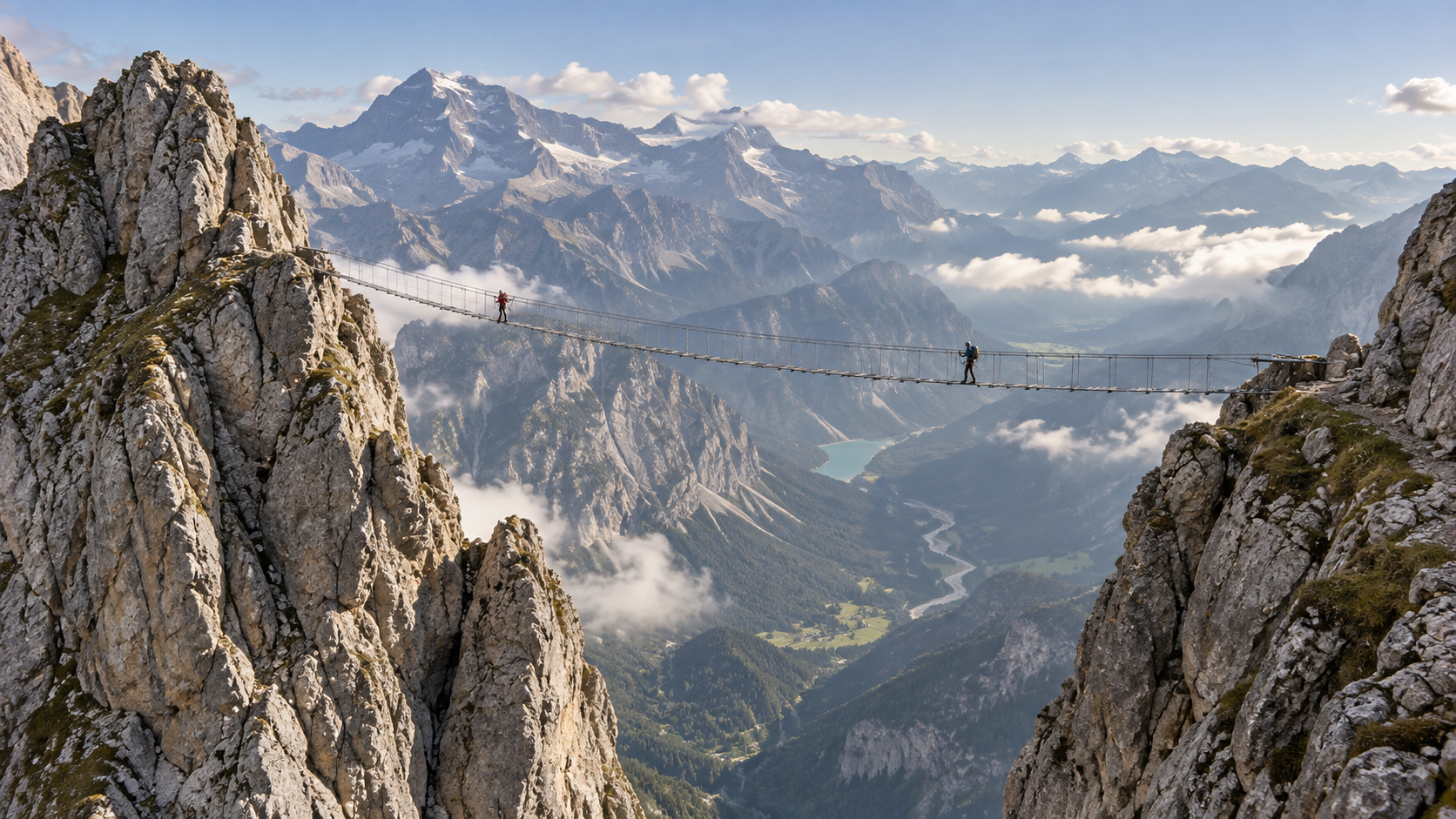
The difficulty of a via ferrata bridge is not decided by its nickname, but by its structure. What matters is whether you move on one, two or three cables, whether there is a walkway under your feet, how much the bridge moves, and where the designated safety cable runs. Names can help with orientation, but you will move safely only if, before stepping on, you quickly “read” the structure of the bridge itself.
The same three-cable bridge may be called Nepalese, Tibetan or Burmese depending on the route or country.
With two cables you do more balance work; with three cables the two side handlines make the crossing noticeably more stable.
A basic principle from DAV and Petzl is that only one climber should be on a cable section between two anchor points at a time.
On long, light structures the swing is usually stronger in the middle than at the entrance or exit.
- Look at the structure first One foot cable + one hand cable = two-cable bridge; one foot cable + two side hand cables = three-cable bridge.
- Always clip into the designated safety cable A handline or support cable is not automatically the life-safety cable.
- Short steps, soft knees Do not yank the structure, and do not try to beat the swing with speed.
- Wait for the section to clear Overtaking, standing side by side, or deliberately making the bridge swing has no place on a via ferrata bridge.
The name is only a clue; the structure decides
The most common via ferrata bridge names in one table
Names change from country to country and route to route, so the structural description in the middle is what matters most.| Name | Typical structure | Other names you may see |
|---|---|---|
| Monkey bridge | 1 foot cable + 1 upper hand cable. | Pont de singe, two-cable bridge. |
| Postman’s Walk | 1 foot cable + 1 hand cable; common in English-language descriptions. | Two-line bridge, dual-cable bridge. |
| Nepalese bridge | 1 foot cable + 2 side hand cables, with a V-shaped cross-section. | Nepal bridge, pont népalais, Dreiseilbrücke. |
| Tibetan bridge | Most often the same basic three-cable form. | Pont tibétain, Tibetan bridge. |
| Vietnamese bridge | Not fully standardised: in Hungarian descriptions the name is used for both 2-cable and 3-cable versions. | Vietnamese bridge; always check the actual structure. |
| Burmese bridge | Typically 3 cables; some versions may have short stabilising connectors. | Burma bridge, three-line bridge. |
| Passerelle / footbridge | A plank, grate or other walkway underfoot, with handlines and protection beside or above it. | Footbridge, walkway, Steg. |
| Himalayan bridge | Often a long suspension bridge with a walkway and side cables. | Pont himalayen, Himalayan bridge. |
| Beam bridge | A narrow beam or plank underfoot, with separate handline and safety cable. | Beam bridge, poutre, catwalk. |
| Ladder bridge | A horizontally or slightly inclined suspended ladder or ladder-like frame. | Ladder bridge, cable ladder bridge. |
| Suspended planks | Separate moving planks or wooden slats one after another. | Suspended plank bridge, alternating plank bridge. |
Do not try to guess the technique from the name alone. Before stepping on, check how many cables there are, where the designated safety cable is, and whether there is a stable walkway.
Monkey bridge and Postman’s Walk: here balance is the main task
One cable for the feet, one for the hands
A two-cable bridge feels much more exposed because there are no two side handlines to hold your body between.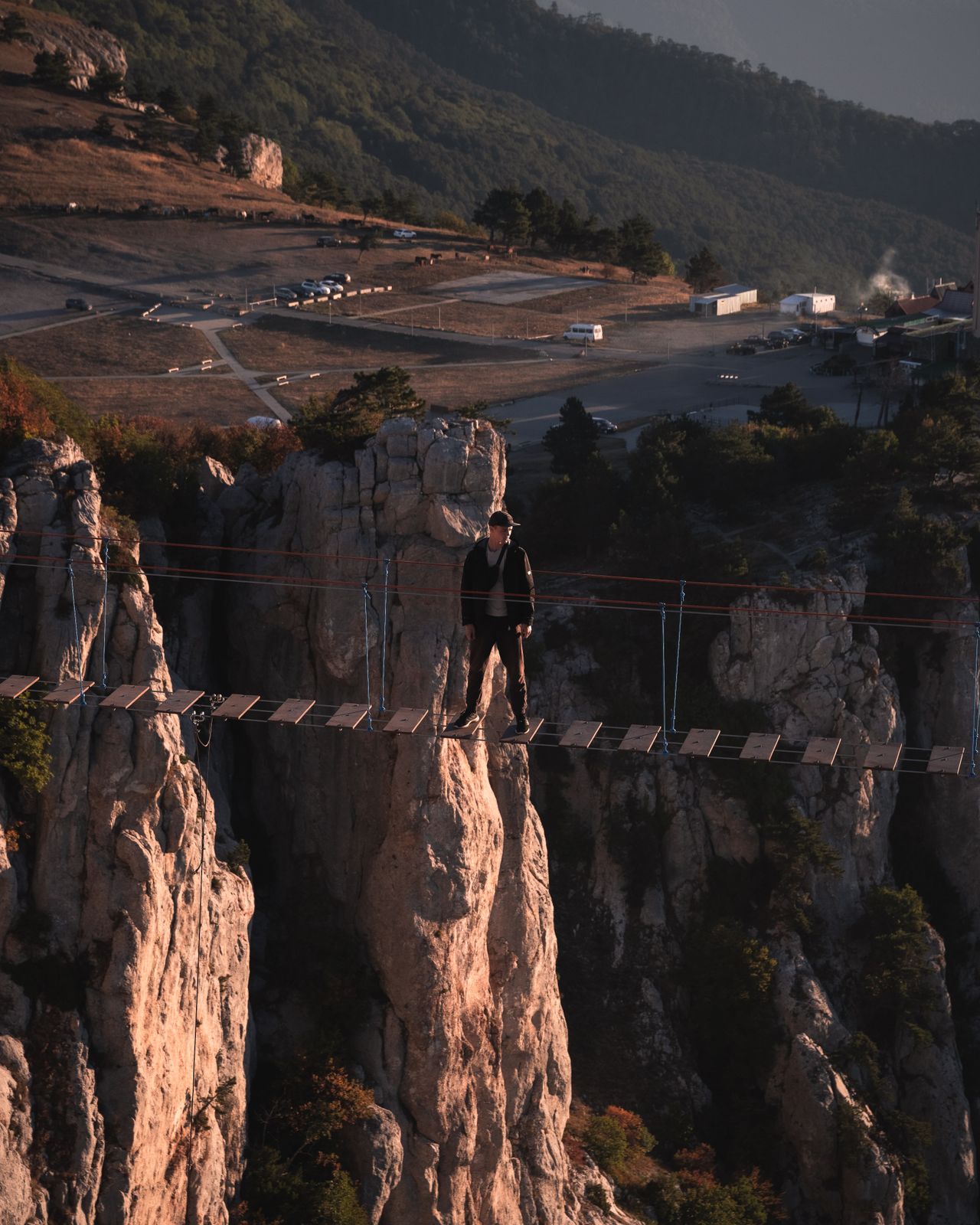
The most common mistake is taking steps that are too big. If your foot gets too far ahead of your body, you instinctively yank the upper cable, which makes the bridge move even more. Short steps + calm rhythm are usually both faster and safer than rushing.
The classic V-shaped three-cable form is more stable, but on a long span it is still a living structure
One lower foot cable, two side hand cables
This is the easiest via ferrata bridge shape to recognise; French and German descriptions also often give it a separate name.- Move in a forward-facing body position. It is easier to keep your centre of gravity in the middle between the two side cables.
- Use both side hand cables. Lean on them lightly, but do not pull them hard towards yourself.
- Keep your knees slightly bent. This helps you absorb the movement without becoming rigid.
- Keep your steps short. On a long bridge the middle section gives back more movement than the two ends.
- Do not automatically copy the pace of the person ahead. Move according to your own balance.
In many topos these two names refer to the same basic three-cable form. In practice the name difference matters less than checking whether the bridge really consists of one lower and two side cables.
With these names, the key rule is simple: always trust the structure in front of you
The use of “Vietnamese bridge” is not fully consistent
This is not a mistranslation; it is a real difference in usage.In Hungarian via ferrata descriptions the term Vietnamese bridge appears regularly. For example, the Hungarian Mountaineering and Climbing Federation uses it for bridge elements on several routes near Tatabánya. At the same time, some Hungarian-language materials use the name for a structure with one lower and two upper cables, while some Transylvanian descriptions mention it as a two-cable bridge. Because of that, this is exactly the kind of name where you must look not only at the sign or topo, but also at the bridge itself.
Treat it as a two-cable bridge
With one foot cable and one hand cable, balance work becomes the main challenge.
Treat it like a Nepalese or Tibetan basic form
With one foot cable and two side hand cables, standard three-cable technique applies.
A Burmese bridge is usually three-line, but may include extra connectors
In some systems short connectors or separate footholds appear between the hand and foot cables.The term “Burma bridge” is often used simply as a synonym for a three-cable bridge. Other descriptions, however, make a distinction and mention short connecting elements or additional footholds on the Burmese version. That makes the bridge feel less like a “pure rope dance”, but the individual parts can also move separately.
Again, the label is not the decisive part: if the structure is made of three continuous cables, three-cable technique works; if you see separate suspended elements, load them one by one and do not try to step over two moving elements at once.
Hungarian examples with “Vietnamese bridge”
The term is genuinely part of Hungarian via ferrata vocabulary.If there is a walkway, the crossing feels friendlier – but the movement can still fool you
Passerelle and Himalayan suspension bridge
You have a plank or grate under your feet, but a long span and wind can still create serious movement.
- Walk normally, but with shorter steps. Do not try to “run through” the movement of the bridge.
- Use the handlines lightly. Hard alternating pulls on the two sides only increase the swing.
- Step in the middle of the plank. On separately moving boards, first load one properly and only then bring the other foot across.
- Look ahead, not only down. An overly downward focus often worsens your sense of balance.
In Alpine and French descriptions, a “Himalayan bridge” often means a true suspension bridge with a walkway. That differs from a Nepalese bridge made of three bare cables, even if the two names sometimes blur together.
Beam bridge, ladder bridge and suspended planks
Here the character of the footholds matters more than the name itself.| Type | How should you move? | Typical mistake |
|---|---|---|
| Beam bridge | Keep your foot aligned with the beam’s long axis, take short steps, and use the handline mainly for balance. | Too much sideways lean. |
| Ladder bridge | Step in the middle of each rung, not on the connections; keep your protection disciplined all the way. | Skipping two rungs or making rushed cross-steps. |
| Suspended planks | Transfer your bodyweight clearly onto one moving element at a time. | Spreading your stance wide across two different swinging planks. |
| Narrow footbridge | Look ahead, hold the rail lightly, and do not lean your full bodyweight onto it. | Stopping for photos on the most mobile middle section. |
A Tyrolean traverse or a zipline may also cross a void, but technically it is not a via ferrata bridge
Tyrolean traverse, tyrolienne, zipline: do not treat these as walkable bridges
Here the route-specific rules and any required special equipment are more important than anything else.If the topo or on-site sign requires a pulley, a short lanyard or a specific device, do not use the element without it. A via ferrata set alone is not automatic permission for every kind of crossing.
A good crossing is decided before you even step onto the bridge
Rhythm, spacing and correct reclipping matter more than courage
A via ferrata set reduces the consequences of a fall; it is not designed for regularly falling into the system.
| When? | What should you do? |
|---|---|
| Before entry | Wait for the section to be free, put away poles and phone, tighten any loose backpack straps, and identify the designated safety cable. |
| While reclipping | Move the two carabiners one after the other so that at least one always remains on the safety cable. |
| On the bridge | Small steps, slightly bent knees, calm pace. Do not jump and do not yank the structure. |
| Behind another person | Keep the safety section clear; start only when, according to the route rules, you actually have space. |
| At the exit | First find a stable stance, then clip to the next cable. Do not sort out your gear on the last moving element. |
On some bridges a separate life-safety cable runs alongside the handline. Always use the designated protection point, not whichever cable merely looks more convenient.
When should you not start?
Reconsidering the situation in the middle of the bridge is always worse than saying no at the entrance.- In strong, gusty wind, if the bridge already swings with a large amplitude when empty.
- Near storms or lightning – that is not when you stay out on a via ferrata.
- On icy, snowy or clearly slippery walkways, if the route is not open for those conditions.
- If you cannot safely reach the hand cables. For children and shorter users this can be a real exclusion factor.
- If you are already panicking at the entrance. The middle of the bridge is rarely less exposed or calmer.
If someone cannot cross independently because of size, experience or mental state, the solution is not for someone else to rush out beside them on the bridge. In such cases you need an appropriate bypass, a guide, or additional rope protection provided by a qualified professional.
If you only have a few seconds: count the cables, do not try to remember the name
Quick identifier
The structure of the bridge immediately tells you what type of movement to expect.Frequently asked questions
Most misunderstandings usually appear around these points.Are a Nepalese bridge and a Tibetan bridge the same?
In many via ferrata descriptions, yes: one lower foot cable and two side hand cables. Elsewhere the names are used more loosely, so always look at the actual structure.
What exactly is a Vietnamese bridge?
There is no fully standardised international definition. In Hungarian and Transylvanian descriptions you can find examples of both two-cable and three-cable versions.
What is the difference between a Burmese bridge and a Nepalese bridge?
Both are often described as three-cable bridges. Some systems use short connecting elements or separate footholds on the Burmese version.
Can two people step onto a long bridge at the same time?
The on-site rule decides. On a via ferrata safety cable, the general principle is one person per cable section, but on large suspension bridges with a separate walkway the operator may specify a different rule.
Can I clip my carabiners onto the cable I am holding?
Only if that cable is truly the designated life-safety cable. A support or hand cable is not automatically intended for that purpose.
What should I do if fear hits me halfway across?
Do not start rushing and do not turn suddenly. Stabilise your body position, hold the handline securely, look at the next close point, and communicate with your partners. If you cannot continue safely, do not improvise a risky rescue.
“Is this a Nepalese bridge or a Vietnamese bridge?”
The name is interesting, but before crossing it matters more to know how many cables there are, which one is the safety cable, how stable the walkway is, and how many people are allowed on the section at the same time.
Structure → protection → free section → body position → calm rhythm.
If you run through these five points, the via ferrata bridge stops being an “unknown obstacle” and becomes a readable technical element.
Sources and background
Bridge names do not form a perfectly standardised vocabulary in every country. That is why this article always treats the actual structure as primary, even when common topo names are also listed. In the safety sections we followed basic principles from the DAV, Petzl and official or regional via ferrata guides.
- Deutscher Alpenverein — via ferrata protection and continuous clipping
- Petzl — Basic principles of via ferrata: always protected, one person per cable section
- Randoxygène — crossing principles for passerelle, Himalayan bridge and monkey bridge
- ViaFerrata-FR — structural distinctions between passerelle, pont de singe and pont népalais
- Via Ferrata 66 — two-cable monkey bridge, beam variant, three-cable Nepalese and Tibetan bridge
- Trekking Team — structural differences between Nepalbrücke and Burma-Brücke
- Hungarian Mountaineering and Climbing Federation — Hungarian via ferrata routes and Vietnamese bridge elements
- Telex Szépkilátás — Hungarian example mentioning a Vietnamese bridge
- E29 — Vietnamese bridge used for a two-cable structure
- life._.kor / Pexels — hero bridge image
- life._.kor / Pexels — rope-bridge crossing for the first content block
- Giovanni Dall’Orto / Wikimedia Commons — climber on the Via Ferrata dei Picasass Tibetan bridge, CC BY-SA 4.0
- Rüdiger Kratz / Wikimedia Commons — wire bridge on the Via Ferrata Dibona route