Snakebite while hiking: what to do and what to avoid
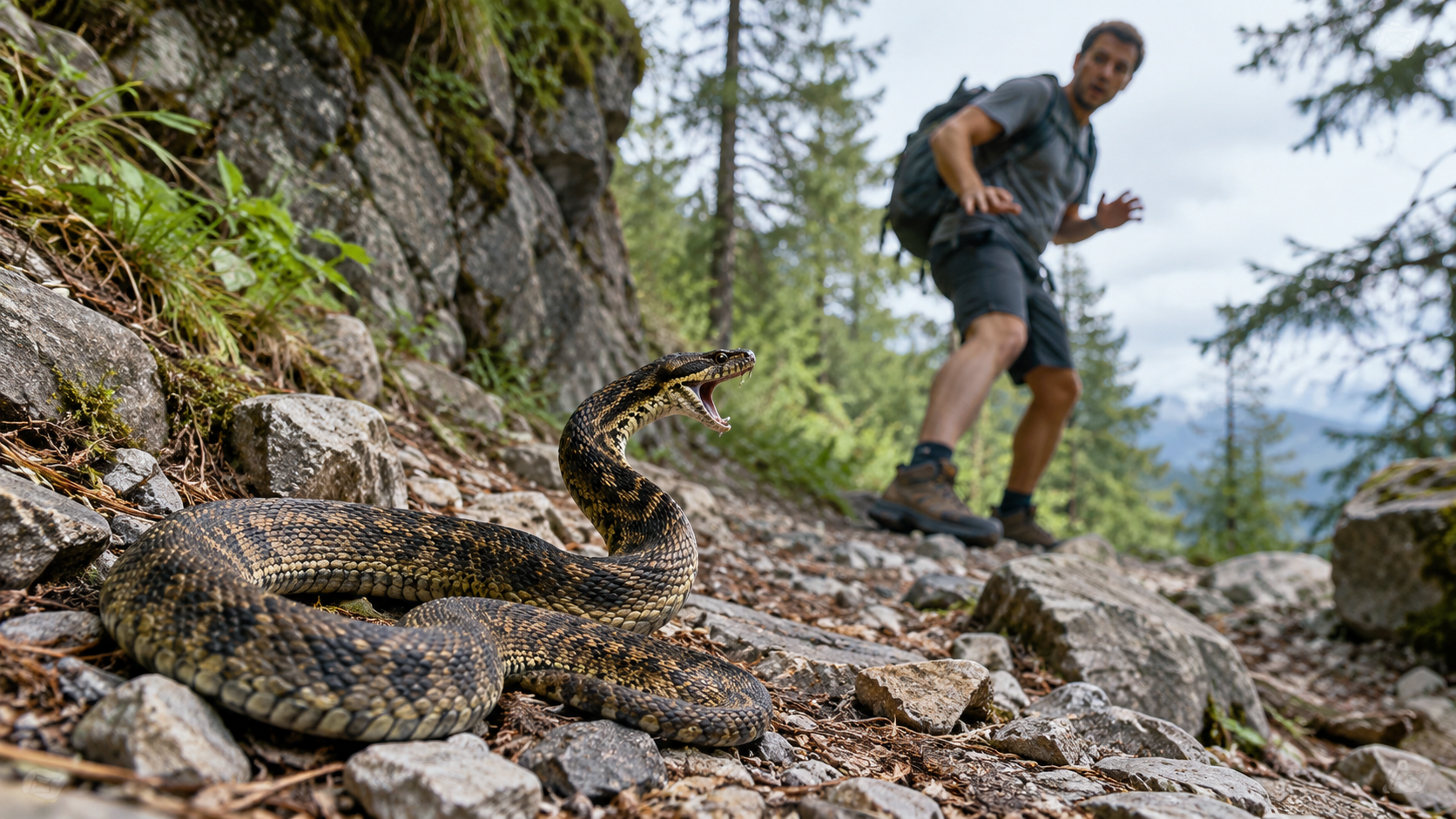
After a snakebite, decisions should be based on the symptoms and circumstances of the bite, not the snake’s colour. If a venomous viper bite is suspected in Hungary, call 112 and seek emergency medical care. This article compares the effects of different European viper venoms, explains which symptoms indicate severe envenoming, and describes hospital treatment. Bites from Hungary’s non-venomous snakes are covered separately.
Call 112 and seek emergency assessment. Do not wait for symptoms to develop.
Fainting, shortness of breath, repeated vomiting or rapidly spreading swelling.
Tourniquets, venom suction, cutting the wound or applying ice.
When indicated, antivenom is administered in hospital under medical supervision.
- Suspected viper or unidentified snake: call 112Do not wait for symptoms if a viper bite is suspected.
- Minimise movement; remove jewelleryKeep the bitten limb still and supported.
- No constriction or home remediesVenom cannot be sucked out, cut out or neutralised with ice.
Snakebite: what to do in the first few minutes
Specific first aid without unnecessary detours
If a viper bite is suspected, call 112 and arrange urgent medical assessment. A bite from a European adder can initially appear mild, with more serious symptoms developing later.
Do not apply a tourniquet, cut the wound, suck out venom or apply ice. If the casualty faints, has difficulty breathing, becomes confused or vomits repeatedly, inform the emergency dispatcher immediately.

Dry bite, mild, moderate or severe envenoming
What does worsening symptom severity mean?
Bite severity is not determined by two fang marks, the snake’s length or pain during the first five minutes. Clinicians assess the spread of swelling, circulation and laboratory findings together.
| Condition | What might you notice? | What should you do? |
|---|---|---|
| Dry bite | Fang marks may be present, but no significant venom effects occur. | You cannot reliably identify a dry bite at home. Suspected viper bites still require medical observation. |
| Mild local reaction | Pain, slight swelling and redness around the bite. | Emergency assessment and symptom monitoring; antivenom is not automatically required. |
| Moderate envenoming | Significant, spreading swelling, vomiting, feeling unwell and possibly low blood pressure. | Urgent hospital treatment; clinicians consider whether antivenom is indicated. |
| Severe envenoming | Fainting, shock, breathing difficulties, major clotting abnormalities and, rarely, neurological symptoms. | Immediate emergency treatment, with antivenom and intensive care when needed. |
The table helps explain symptoms; it is not a tool for deciding whether to call for help. Even initially mild symptoms warrant medical assessment when a viper bite is suspected.
What exactly do European viper venoms do?
Effects on tissue, circulation and the nervous system
European viper venom is not a single toxin, but a mixture of proteins and enzymes. Its composition, and the quantity injected, vary between species and individual bites.
| Effect | What happens in the body? | What can you observe? |
|---|---|---|
| Local tissue and blood-vessel effects | Increased vascular permeability, inflammation and fluid leakage into tissues; sometimes bruising or blisters. | Painful spreading swelling, redness and purple discoloration. |
| Circulatory and blood-clotting effects | Low blood pressure and changes in platelet count or clotting can occur, particularly after nose-horned viper bites. | Dizziness, fainting, vomiting and bruising; clotting abnormalities may only be detectable in blood tests. |
| Neurological effects | Some components of certain viper venoms can disrupt nerve–muscle function. | Less commonly, drooping eyelids, double vision, difficulty swallowing or breathing. |
It would be misleading to claim that one species’ venom is simply “twice as strong” as another’s. Laboratory toxicity does not equal clinical severity in humans. The following sections therefore compare documented health risks.
European adder and Hungarian meadow viper: the key differences
Two species with different risks of envenoming
Hungary has two native venomous snake species. The nose-horned viper (Vipera ammodytes) is not native to Hungary and must not be confused with the Hungarian meadow viper.
European adder (Vipera berus)
Significant risk; severe envenoming is possible but uncommon- Where?
- In scattered habitats, mainly in parts of north-eastern and south-western Hungary.
- Can it bite?
- Yes, venomous bites are possible.
- Venom effects
- Local tissue and vascular effects; circulation may also be affected.
- Symptoms
- Painful swelling, nausea and dizziness; in more serious cases, low blood pressure, fainting or breathing difficulties.
- Response
- Call 112, keep the limb still and seek emergency care. Clinicians may administer antivenom if symptoms spread or worsen.
Hungarian meadow viper (Vipera ursinii rakosiensis)
Generally milder envenoming; bites are exceptionally rare- Where?
- Restricted, protected grassland habitats, including the Hanság and Kiskunság areas.
- Can it bite?
- Yes, venomous bites are possible.
- Venom effects
- Relatively weak venom, acting mainly locally.
- Symptoms
- Usually local pain, swelling and itching; systemic symptoms are uncommon.
- Response
- Medical examination is warranted even after a reliably identified bite. Do not assume that a bite is harmless simply because the species is considered less dangerous.


Nose-horned vipers and other species: where are more severe bites possible?
Species, venoms and distribution across borders
In countries neighbouring Hungary, the European adder occurs alongside the nose-horned viper, which is often of greater clinical concern closer to the Balkans. Species distribution varies by region: not every viper occurs throughout every country’s mountains.
Nose-horned viper (Vipera ammodytes)
More likely to cause severe envenoming- Where?
- Mainly in parts of Croatia, Slovenia, Serbia and Romania, and in very localised habitats in southern Austria.
- Can it bite?
- Yes, venomous bites are possible.
- Venom effects
- Marked local inflammation, reduced platelet count, circulatory effects and, less commonly, neurological effects.
- Symptoms
- Severe pain, rapid swelling, vomiting and dizziness; in serious cases, shock, clotting abnormalities or neurological symptoms.
- Response
- Call 112 and seek hospital care. Antivenom is required more frequently than for European adder bites.

| Country | Viper species most relevant to consider | Practical significance |
|---|---|---|
| Slovakia | European adder. | Treat a suspected viper bite in the mountains as an emergency. |
| Austria | European adder; nose-horned viper in isolated areas in the south. | The nose-horned viper is not widespread throughout Austria. |
| Slovenia | European adder and nose-horned viper; asp viper in some areas. | Nose-horned vipers are particularly relevant in rocky southern areas. |
| Croatia | Nose-horned viper, plus European adder in certain regions. | Nose-horned vipers are an important risk in rocky karst habitats. |
| Serbia | Nose-horned viper and European adder, with differing regional ranges. | Treatment depends on the clinical severity, not the name of the country. |
| Romania | European adder; nose-horned viper in some regions; smaller populations of steppe vipers. | Species vary between regions and mountain areas. |
| Ukraine | European adder; steppe vipers in some regions. | Distribution is not uniform; the clinical signs of the bite matter most. |
In a 2018–2020 Central and South-Eastern European study, Vipera ammodytes bites were treated with antivenom in 72% of cases, compared with Vipera berus bites, for which 39% of cases received antivenom. This does not mean that every nose-horned viper bite is life-threatening, but that specific treatment was more often indicated among the cases studied.
Hungary’s five non-venomous snakes: which bite, and what can happen?
Not viper envenoming, but wound care still matters
Hungary’s five non-venomous snake species do not cause viper venom poisoning. However, any may bite in self-defence; grass snakes and dice snakes do so particularly rarely.
| Species | Bite behaviour | Risk and treatment |
|---|---|---|
| Aesculapian snake (Zamenis longissimus) | May bite when handled or restrained. | Non-venomous; may cause a small wound and local pain. Wash the wound and seek wound assessment if necessary. |
| Smooth snake (Coronella austriaca) | May bite in self-defence. | Non-venomous; small, sometimes bleeding punctures are possible. Wash the wound and check tetanus protection if needed. |
| Caspian whipsnake (Dolichophis caspius) | May bite vigorously when defending itself. | Non-venomous; teeth can cause a painful, bleeding wound. Provide normal wound care. |
| Grass snake (Natrix natrix) | Rarely bites; usually attempts to escape. | It has no viper-type venom dangerous to humans. If bitten, clean and assess the wound. |
| Dice snake (Natrix tessellata) | Bites very rarely. | Not viper envenoming; if the skin is broken, wash and provide ordinary wound care. |

If you did not see the snake clearly or are uncertain of the species, do not automatically treat the bite as a non-venomous snakebite. Body markings and pupil shape are not reliable diagnostic methods in the field.
When is antivenom needed, and how does it work?
Treatment selected according to species and clinical condition
Antivenom contains ready-made antibodiesthat bind venom components circulating in the blood. It is not a home remedy or a general painkiller, and it is not necessary after every bite. It may not reverse tissue damage that has already developed.
| How does the hospital decide? | What happens? |
|---|---|
| Species and available antivenom | Several antivenoms targeting different European viper venoms are used in Europe. Clinicians select a product according to local toxicology protocols and availability. |
| Spreading swelling and systemic illness | Rapidly increasing swelling, low blood pressure, repeated vomiting or other systemic symptoms may favour antivenom treatment. |
| Blood count and clotting tests | Platelet count, coagulation studies, kidney function and circulatory monitoring can reveal serious envenoming. |
| Safe administration | Intravenous antivenom can cause allergic reactions, so it must only be administered by suitably trained medical professionals. |
After a Hungarian meadow viper bite, antivenom is usually not needed because symptoms are typically mild and local. After a European adder bite, clinical deterioration and serious symptoms guide treatment. After a nose-horned viper bite, severe envenoming and the need for antivenom are more common.
Treatment effectiveness depends on the bite and the time elapsed. A doctor may still consider antivenom later. A serious mistake is delaying help because someone assumes that “nothing can be done now anyway”.
How can you tell if the casualty is getting worse?
Symptoms do not necessarily appear immediately
Monitor the progression of swelling and the person’s overall condition, rather than the fang marks alone. Severity can change considerably over several hours.
| When / what you see | What it might mean | What to do |
|---|---|---|
| Immediately after the bite | Pain, a small puncture wound or barely visible changes. | Call 112 if a viper bite is suspected; initial lack of symptoms does not exclude venom injection. |
| During the first 1–2 hours | Rapid swelling, vomiting, dizziness or weakness may develop. | Report any deterioration; rapidly developing circulatory or neurological symptoms are urgent. |
| In the following hours | Spreading oedema or bruising; blood tests may show abnormalities. | Hospital observation and repeat examinations may be required. |
| In the days after treatment | Swelling and pain may persist; complications are uncommon. | Follow the hospital’s instructions on follow-up and activity. |
Signs of immediate deterioration: fainting, breathing difficulties, confusion, rapidly spreading swelling, repeated vomiting, or drooping eyelids/double vision. Do not simply wait and hope these symptoms will pass.
Which “first aid” measures can make a snakebite worse?
Common interventions known to be harmful or ineffective
For Central European vipers, pressure immobilisation bandaging is not recommended either: this is often confused with techniques used for certain predominantly neurotoxic snakes on other continents.
| Incorrect intervention | Why is it dangerous? | What to do instead |
|---|---|---|
| Tourniquet or constricting bandage | May impair blood supply to the limb and worsen tissue damage. | Restrict movement, remove jewellery and obtain urgent medical care. |
| Sucking out venom / “snakebite extraction kit” | Does not remove a meaningful amount of venom and may cause injury. | Do not manipulate the wound. |
| Cutting or squeezing the wound | Increases the risk of bleeding and infection without removing venom. | If needed, rinse with clean water and cover loosely. |
| Ice, burning or electric shocks | Can damage tissue and do not neutralise venom. | Keep the affected limb still. |
| Calcium, alcohol or “home antidotes” | Do not replace specific hospital treatment. | Seek care directed by a doctor. |
Identifying the species may help clinicians, but it never justifies risking another bite. Do not handle the snake or take it to hospital.
What actually reduces the risk of being bitten?
Real risk factors rather than an unnecessary equipment list
Many bites occur when a snake defends itself because someone steps on it, handles it or accidentally reaches towards it among rocks or wood. Three practical ways to reduce the risk:
- Never reach blindly into rock crevices or beneath stones and logs. When climbing or resting, look before placing your hands.
- Wear closed shoes and long trousers in dense vegetation. They do not offer complete protection, but they reduce direct contact.
- Do not approach or attempt to move a snake you have spotted. Step back and let it leave. Handling a snake, even to identify it, is a poor decision.

What does a bite mean, and what is the right response?
Call 112; do not wait for symptoms
For suspected viper bites, first aid means minimising movement, removing tight items and urgently seeking medical assistance.
Fang marks do not determine severity
Envenoming can range from a dry bite to a life-threatening event. Rapidly spreading swelling, vomiting, fainting and breathing difficulties are serious signs.
The hospital selects treatment
Viper antivenom is not needed in every case, but may be lifesaving in severe envenoming; only clinicians can choose the appropriate product.


Sources and professional background
Sources: Hungary’s Egészségvonal health portal (viper bites), WHO first aid guidance, MME species descriptions and clinical studies from Central and South-Eastern Europe. The severity categories are informative, not a basis for self-diagnosis. Updated: 31 October 2026.
Medical and wildlife-conservation sources:
- Egészségvonal – Viper bites, first aid and emergency treatment
- WHO – Snakebite first aid and treatment
- IFRC – International First Aid Guidelines 2025, Snakebite
- MME – Native snake species in Hungary
- MME – European adder
- MME – Hungarian meadow viper
- MME – Smooth snake
- Clinical Toxicology (2023) – study of viper bites in Central and South-Eastern Europe
- IUCN – Nose-horned viper distribution
- Naturschutzbund Steiermark – Nose-horned viper in Austria
- Societatea Ornitologică Română – Nose-horned viper in Romania
- Helsenorge – European adder bites: mild and severe envenoming
- Clinical Toxicology – Viper envenomation in Central and Southeastern Europe (2023)
- European viper venom – clinical review (PMC)
Photographs – authors, original files and licences: The links below lead to the image attribution and licensing records. The images appear on the website in a 16:9 crop. The location where a photograph was taken does not imply that the species occurs throughout Hungary.
- European adder (Vipera berus), in its natural habitat: A S Begbie – original photo · CC BY 4.0.
- European adder (Vipera berus): Bee2sea – photo · CC BY-SA 4.0.
- Hungarian meadow viper (Vipera ursinii rakosiensis): Pellinger Attila – photo · CC BY-SA 3.0.
- Nose-horned viper (Vipera ammodytes): Benny Trapp – photo · CC BY 3.0.
- Smooth snake (Coronella austriaca): Christian Fischer – photo · CC BY-SA 3.0.
- European adder on a path (Vipera berus): BabelStone – photo · CC BY-SA 3.0.
The article’s featured image comes unchanged from an earlier Túranavigátor upload. Image attribution and licence conditions were checked against the original Commons file pages.